
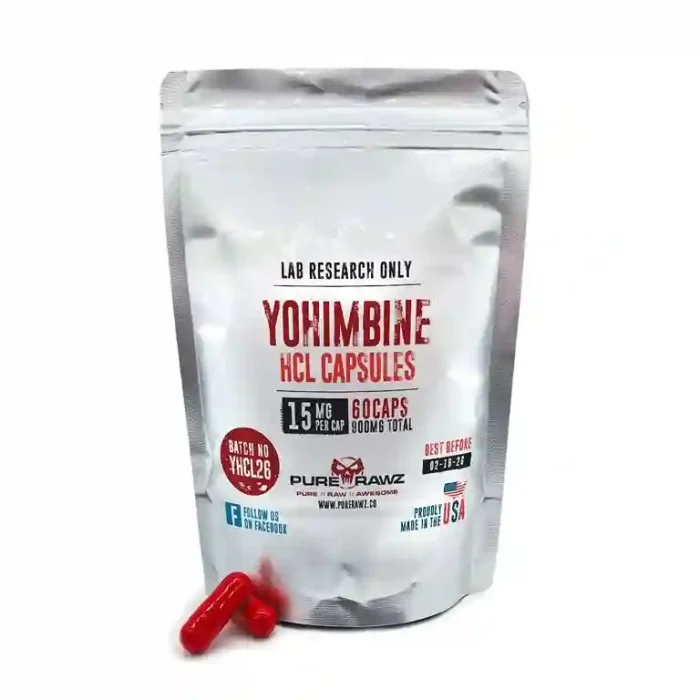
Yohimbine HCL Overview
Yohimbine HCl is an alkaloid compound derived from the bark of the African evergreen tree Pausinystalia yohimbe, which is native to regions of Central and West Africa. The compound has been isolated and studied for its interaction with adrenergic receptors and related neurotransmitter signaling pathways.
In laboratory environments, Yohimbine HCl is frequently investigated for its influence on adrenergic receptor activity, neurotransmitter modulation, and related physiological signaling mechanisms. These research investigations focus on receptor-binding properties and the compound’s potential effects on cellular communication pathways associated with norepinephrine and other catecholamines.
Chemical and Molecular Properties
| PubChem CID | 6169 |
| Molecular Formula | C21H27ClN2O3 |
| Molecular Weight | 390.9 g/mol |
| Synonyms | YOHIMBINE HYDROCHLORIDE
65-19-0 NB2E1YP49F NSC-19509 |
| IUPAC | methyl (1S,15R,18S,19R,20S)-18-hydroxy-1,3,11,12,14,15,16,17,18,19,20,21-dodecahydroyohimban-19-carboxylate;hydrochloride |
| CAS | 65-19-0 |
| Labeling | Research Use Only (RUO), not for human or animal consumption. |
| Chemical Structure Depiction |  |
| Purity | 99% Purity |
| Classification | Research Use Only (RUO) |
| Storage Temperature | Store at controlled room temperature, 20°C to 25°C (68°F to 77°F) |
Mechanisms of Action
In experimental models, the Yohimbine HCL research compound has been associated with increased norepinephrine activity and modulation of catecholamine signaling pathways. These neurochemical changes may influence several physiological processes that are currently under investigation in laboratory environments.
Research literature also indicates that Yohimbine HCl may interact with multiple receptor systems, including:
- Alpha-1 and alpha-2 adrenergic receptors
- Dopamine receptors (D2 and D3)
- Serotonin receptors including 5-HT1B, 5-HT1D, 5-HT2A, and 5-HT2B
Through these receptor interactions, Yohimbine HCl has been observed in experimental settings to influence neurotransmitter activity, cardiovascular signaling pathways, and metabolic regulatory mechanisms.
Potential Research Applications
Yohimbine HCl has been explored in scientific literature across several experimental models. Researchers investigate the compound primarily for its role in adrenergic receptor activity and its influence on neurochemical signaling pathways.
Yohimbine HCl and Metabolic Research
Some experimental studies have explored Yohimbine HCl in relation to metabolic processes and lipid metabolism.
Yohimbine HCl and Neurochemical Signaling
Yohimbine HCl has been investigated for its interaction with norepinephrine-related signaling pathways. Some experimental studies have examined whether adrenergic receptor modulation may influence fear extinction processes and behavioral responses among animal models.
Yohimbine HCl and Salivary Secretion Studies
In limited experimental settings, Yohimbine HCl has been investigated for its potential influence on salivary gland activity. Certain small-scale studies observed measurable increases in salivary flow in animal models.
Yohimbine HCl and Cognitive Research
Researchers have also examined Yohimbine HCl in studies involving norepinephrine-mediated cognitive signaling pathways. Certain investigations reported changes in long-term memory performance associated with increased norepinephrine activity.
Disclaimer
This information is for educational purposes only and not medical advice. Products are for research use only. Research must follow IRB or IACUC guidelines. Verify information independently before purchasing. By ordering, you agree to our Terms and Conditions. If you are not 100% satisfied with the product you received, please contact us at support@purerawz.co
ATTENTION: All our products are for LABORATORY AND RESEARCH PURPOSES ONLY, not for veterinary or human use
References:
- Sandberg, M., Pettersson, U., Henriksnas, J., & Jansson, L. (2012). The A2-Adrenoceptor antagonist yohimbine normalizes increased islet blood flow in GK rats: a model of Type 2 diabetes. Hormone and Metabolic Research, 45(03), 252-254. https://doi.org/10.1055/s-0032-1323843
- Zhang, M., & Cai, J. (2005). Extract of Ginkgo biloba leaves reverses yohimbine-induced spatial working memory deficit in rats. Behavioural Pharmacology, 16(8), 651-656. https://doi.org/10.1097/00008877-200512000-00008
- Plasma catecholamine levels and lipid mobilization induced by yohimbine in obese and non-obese women. (1991, May 1). PubMed. https://pubmed.ncbi.nlm.nih.gov/1885256/


Reviews
There are no reviews yet.